Autonomous Vehicle Deployment: Real-World Challenges

Autonomous Vehicle Deployment: Real-World Challenges
The autonomous vehicle industry has reached an inflection point. What once seemed like pure science fiction—cars navigating city streets without human intervention—is now happening in Phoenix, San Francisco, and Austin. Yet here's the uncomfortable truth: the gap between controlled testing environments and actual road deployment remains vast. Engineers are discovering that simulation alone cannot predict the thousands of edge cases waiting in real-world traffic. The industry is learning hard lessons about infrastructure complexity, regulatory uncertainty, and the sheer operational burden of managing autonomous fleets at scale. This analysis examines what autonomous vehicle deployments are revealing about the true challenges ahead, moving beyond hype to explore the technical and operational realities that will determine whether this technology becomes mainstream or remains confined to narrow use cases.
Edge Cases and Environmental Factors That Challenge Autonomous Systems
Autonomous vehicles operate within defined operational design domains (ODDs)—essentially the specific conditions under which they're designed to function. But here's where theory meets messy reality: the real world doesn't respect boundaries. Heavy rain, snow, unpaved roads, and unmapped areas create scenarios that autonomous systems struggle to handle reliably. These aren't minor inconveniences; they're fundamental limitations that constrain where and when these vehicles can operate.
Consider the sensor challenge. Most advanced autonomous vehicles rely on lidar (light detection and ranging) sensors, cameras, and radar to perceive their environment. Lidar works brilliantly in clear conditions but degrades significantly in heavy precipitation. Rain and snow scatter laser light, creating phantom obstacles and obscuring real ones. A vehicle trained on sunny California roads may freeze in confusion during a Chicago winter. This isn't a software bug—it's a physics problem.
The complexity multiplies when you factor in unpredictable human behavior. Autonomous systems are trained on patterns, but humans are pattern-breakers. A cyclist riding against traffic, a pedestrian stepping between parked cars, a delivery driver double-parked in an intersection—these scenarios occur constantly in urban environments. While machine learning models improve with exposure to more data, they never achieve perfect prediction. The question becomes: at what confidence threshold is the system safe enough to deploy?
Weather variability across regions adds another layer. A robotaxi service that works flawlessly in Phoenix's consistent climate faces entirely different challenges in cities with seasonal weather changes. The infrastructure, training data, and sensor calibration all need adjustment. This geographic fragmentation means that scaling autonomous vehicles isn't simply a matter of copying a successful model to new cities—it requires substantial re-engineering for each region's unique environmental conditions.
Sensor Limitations in Adverse Conditions
Lidar sensors, while revolutionary, have fundamental physical limitations. They emit laser pulses and measure reflections to create 3D maps of the environment. In heavy rain or snow, these pulses scatter before reaching distant objects, creating blind spots. Camera systems struggle with glare and reduced visibility. Radar performs better in adverse weather but provides lower resolution data. The industry's solution? Sensor fusion—combining multiple sensor types to compensate for individual weaknesses. Yet this approach increases computational load, power consumption, and system cost, creating a trade-off between reliability and affordability.
Unpredictable Human Behavior and Edge Cases
Humans are creative rule-breakers. They jaywalk, they ignore traffic signals, they make eye contact with drivers to negotiate right-of-way. Autonomous systems trained on statistical patterns struggle with these intentional deviations. A pedestrian might step into traffic expecting a driver to brake—a behavior that's illegal but common. Autonomous vehicles must be programmed conservatively to handle these scenarios, often resulting in overly cautious behavior that can itself create traffic problems or seem unnatural to other road users.
The Simulation-to-Reality Gap in Autonomous Technology
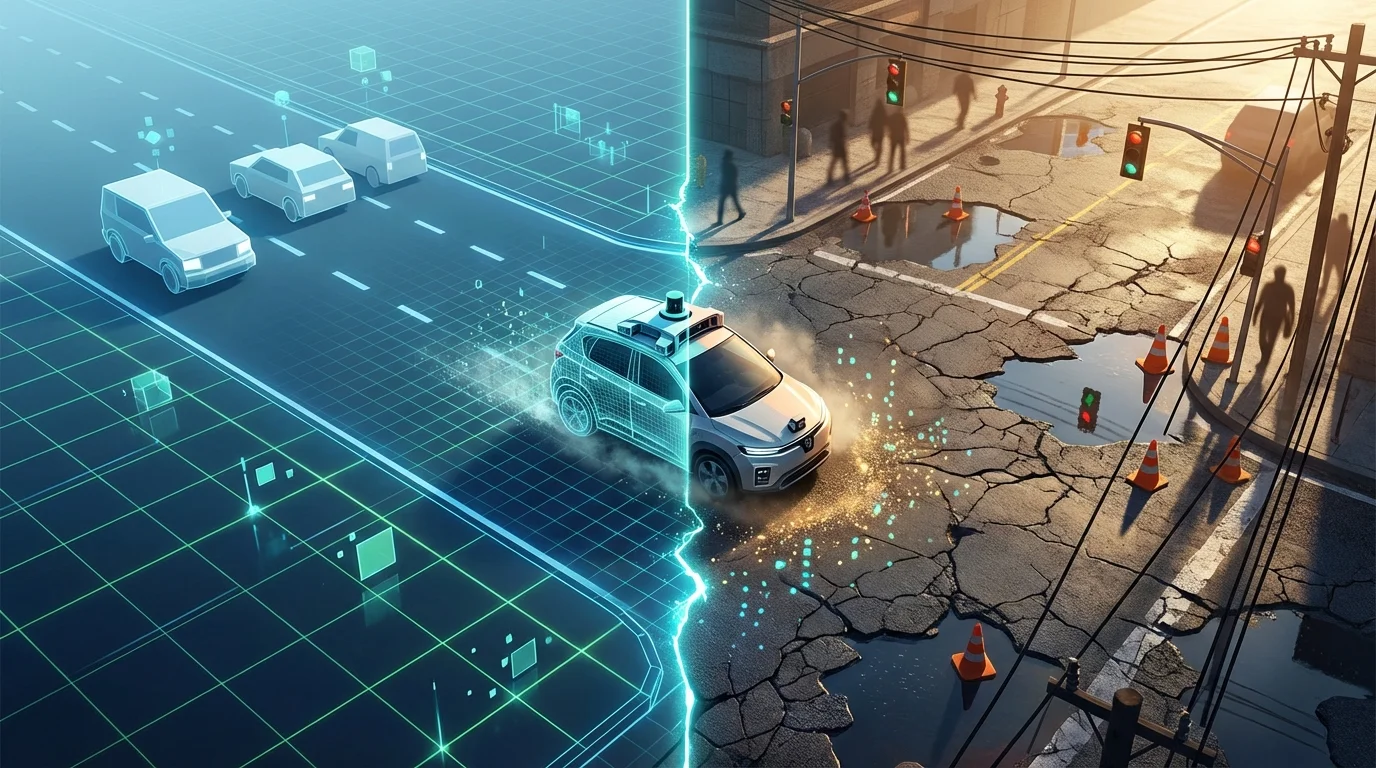
Here's a sobering reality: simulation is not reality. Autonomous vehicle companies invest billions in creating digital environments where vehicles can be tested millions of miles without physical risk. Tesla, Waymo, and others run extensive simulations to validate their algorithms. Yet when these same vehicles hit actual roads, they encounter scenarios that simulations never predicted.
The problem stems from what researchers call the "long tail" of edge cases. Simulations excel at testing common scenarios—normal traffic, standard weather, typical road conditions. But the truly dangerous situations are rare. A child chasing a ball into traffic happens infrequently enough that it might not appear in millions of simulated miles. Yet it happens regularly in real cities. Simulations can't efficiently generate these rare-but-critical scenarios because they're statistically unlikely.
There's also the challenge of simulation fidelity. Creating a perfect digital replica of the real world is computationally impossible. Simulations make simplifying assumptions about physics, sensor behavior, and traffic patterns. These assumptions work fine for common cases but break down in unusual situations. A pothole that's barely noticeable to a human driver might confuse a vision system trained on smooth roads. A reflection in a puddle might be misinterpreted as an obstacle.
Waymo's approach illustrates this tension. The company operates smaller, geo-fenced fleets with extensive sensor hardware and highly detailed maps of their operating areas. This strategy reduces the simulation-to-reality gap by constraining the problem space. Tesla's approach aims for broader applicability with less specialized hardware, accepting more reliance on simulation and real-world learning. These competing philosophies represent different bets on how to bridge the gap between controlled testing and real-world deployment.
Why Simulations Miss Critical Scenarios
Simulations optimize for computational efficiency, which means they often oversimplify complex interactions. Traffic behavior, weather effects, and sensor noise are modeled as statistical distributions rather than captured in full fidelity. This works for validating normal operation but fails for rare, dangerous scenarios. Additionally, simulations can't account for novel situations—scenarios that developers never anticipated and therefore never programmed into the simulation environment.
Real-World Data Collection and Continuous Learning
Autonomous vehicle companies now treat real-world deployment as extended testing. Every mile driven generates data about edge cases, sensor performance, and system failures. This data feeds back into model improvement, but it creates a chicken-and-egg problem: you need real-world deployment to identify critical edge cases, but you need to identify those cases before deploying at scale. The industry is navigating this by starting with limited deployments in controlled geographic areas, then gradually expanding.
Operational Complexity Beyond the Algorithm
Engineers often focus on the autonomous driving algorithm—the software that makes decisions about steering, acceleration, and braking. But successful autonomous vehicle operations require solving dozens of problems that have nothing to do with driving algorithms. These operational challenges may ultimately prove more difficult than the technical ones.
Fleet management at scale is genuinely complex. Imagine managing hundreds or thousands of vehicles across a city. Each vehicle needs charging, maintenance, cleaning, and repositioning. A robotaxi that completes a ride in downtown Phoenix needs to be positioned for the next customer, which might be across town. This creates inefficiencies that don't exist with human drivers, who naturally position themselves for demand. Autonomous fleets require sophisticated algorithms to optimize vehicle positioning, predict demand, and manage charging infrastructure.
Safety protocols introduce another layer of complexity. What happens when an autonomous vehicle encounters a situation it can't handle? Current systems typically alert a remote operator who can take control or guide the vehicle to a safe location. But scaling this requires building call centers with trained operators available 24/7. Waymo operates such centers; it's expensive and doesn't scale as easily as the technology itself.
Infrastructure requirements are substantial. High-speed connectivity is essential for remote operation and real-time updates. Charging infrastructure must be deployed across service areas. Maintenance facilities need specialized equipment to diagnose and repair autonomous systems. Cities must upgrade roads to enable autonomous operations—better lane markings, updated traffic signals, and potentially dedicated lanes. These infrastructure investments happen slowly and inconsistently across jurisdictions.
Insurance and liability frameworks remain unresolved. Who's responsible when an autonomous vehicle causes an accident? The manufacturer? The operator? The city that approved deployment? Insurance companies are struggling to develop risk models for autonomous vehicles because historical data is limited. Until these frameworks are clarified, insurance costs remain high and unpredictable.
Fleet Management and Vehicle Positioning
Autonomous fleets require predictive algorithms to anticipate demand and position vehicles efficiently. Unlike human drivers who naturally gravitate toward busy areas, autonomous vehicles need explicit instructions. This creates operational overhead and potential inefficiencies. A vehicle might need to drive empty across town to reach the next customer, consuming energy and creating congestion. Optimizing this requires sophisticated machine learning models that predict demand patterns and balance fleet utilization.
Remote Operation and Safety Protocols
Current autonomous vehicles can't handle every situation independently. When they encounter ambiguous scenarios, remote operators take control. This requires building expensive infrastructure—call centers, trained staff, redundant systems. Scaling this approach becomes economically challenging. The industry is working toward systems that need less remote intervention, but we're not there yet. Until then, operational costs remain high.
Infrastructure and Regulatory Coordination
Cities must invest in charging stations, communication networks, and road upgrades to support autonomous vehicles. This requires coordination between municipalities, utilities, and private operators. Progress is slow because infrastructure decisions involve multiple stakeholders with competing interests. Some cities are moving faster than others, creating a patchwork of autonomous vehicle readiness across regions.
Timeline Reality Check: When Will Autonomous Vehicles Actually Be Ready?
Industry timelines have consistently proven optimistic. Predictions made five years ago about autonomous vehicle adoption have largely failed to materialize. Understanding why requires looking at what experts now expect versus what early advocates promised.
The World Economic Forum's 2025 analysis provides a sobering assessment. Robotaxis are expected to operate in 40 to 80 cities globally by 2035, mostly in China and the United States. That's a decade away, and the deployment will be concentrated in a relatively small number of cities. For context, there are thousands of cities worldwide. This suggests that autonomous robotaxis will remain a niche service in specific geographic areas for at least the next decade.
Autonomous trucking presents a different timeline. Long-haul trucking on fixed highway routes aligns well with autonomous vehicle strengths—consistent environments, predictable routes, and fewer edge cases. The industry expects meaningful autonomous truck deployments on major corridors within the next few years. However, challenges remain: ensuring reliability in all weather conditions, securing funding to scale operations, and navigating complex regulations. The technology is closer to deployment than robotaxis, but still faces significant hurdles.
Why are timelines so uncertain? Several factors compound the delays. First, technological breakthroughs remain unpredictable. Map-free, vision-only autonomous driving could accelerate deployment if it proves reliable, but it hasn't yet. Second, regulatory approval moves slowly. Each jurisdiction develops its own rules, creating fragmented requirements that slow scaling. Third, economic viability remains unproven. Waymo has invested billions and still hasn't achieved profitability. General Motors withdrew from the robotaxi market entirely, citing uncertain profitability and regulatory challenges.
The realistic timeline depends on which scenario unfolds. If technological breakthroughs occur and regulators align on standards, deployment could accelerate. If major accidents undermine public trust or regulatory barriers strengthen, deployment could slow dramatically. The industry is essentially betting on multiple uncertain outcomes happening simultaneously.
Robotaxi Deployment Expectations
Current forecasts suggest robotaxis will operate in major cities by 2030-2035, but with significant geographic limitations. Early deployments will likely remain in areas with favorable weather, well-mapped infrastructure, and supportive regulations. Expansion to secondary cities and regions with challenging weather will take longer. The service will remain expensive initially, limiting adoption to customers willing to pay premium prices for convenience.
Autonomous Trucking on Highways
Highway trucking offers a clearer path to near-term deployment. Fixed routes, consistent environments, and high-volume corridors align with current autonomous capabilities. Expect meaningful deployments on major trucking corridors within 3-5 years, though full automation will take longer. Hub-to-hub operations (connecting distribution centers) will likely precede long-haul autonomous trucking.
Factors That Could Accelerate or Delay Deployment
Technological breakthroughs like reliable vision-only driving could accelerate timelines. Conversely, high-profile accidents or regulatory crackdowns could slow deployment significantly. Economic viability remains uncertain—if operators can't achieve profitability, investment will dry up. Policy support varies by region; China's government backing contrasts sharply with Western regulatory skepticism. These variables make precise predictions impossible.
What This Means for Engineers and Entrepreneurs
If you're building in the autonomous vehicle space, the current landscape offers both opportunities and sobering realities. The technology is advancing, but not as quickly as early predictions suggested. Success requires understanding where autonomous vehicles can genuinely add value today, not betting on capabilities that remain years away.
For robotics developers, the lesson is clear: focus on constrained problems. Autonomous vehicles perform best in defined environments with predictable conditions. Waymo's geo-fenced approach, while less ambitious than Tesla's vision, has proven more commercially viable. Building systems that work reliably in specific contexts beats building systems that partially work everywhere.
For AI engineers, the simulation-to-reality gap represents the core challenge. Your models need to handle not just common cases but rare edge cases that simulations miss. This requires different approaches to training and validation. Consider how you'll collect real-world data, how you'll identify failure modes, and how you'll continuously improve models based on deployment experience.
For entrepreneurs, the infrastructure opportunity may be larger than the autonomous vehicle technology itself. Companies building fleet management software, charging infrastructure, remote operation platforms, and safety validation tools are addressing real market needs. These supporting technologies are essential for autonomous vehicle success, and they're less dependent on breakthrough innovations in autonomous driving itself.
The contrarian take: autonomous vehicles may never achieve the 90% crash reduction that advocates predict. Real-world deployment reveals that autonomous systems introduce new risks—increased total vehicle travel, potential for coordinated failures, and challenges managing mixed traffic with human drivers. The safety benefits will likely be more modest than promised, which actually makes the business case harder, not easier.
Building for Constrained Environments
Success in autonomous vehicles increasingly means accepting geographic and operational constraints. Rather than building systems that work everywhere, focus on specific use cases where autonomous technology provides clear advantages. Fixed routes, predictable environments, and well-defined operational domains are where autonomous systems excel. This approach limits market size but increases probability of success.
Infrastructure and Supporting Technologies
The autonomous vehicle ecosystem needs more than just driving algorithms. Fleet management, charging infrastructure, remote operation platforms, and safety validation tools represent substantial opportunities. These supporting technologies are essential for deployment and may prove more commercially viable than autonomous driving technology itself. Consider where your expertise can address these operational challenges.
Conclusion
Autonomous vehicle deployment is happening, but not at the pace or scale that early advocates predicted. The industry is learning that real-world challenges extend far beyond perfecting driving algorithms. Edge cases that simulations miss, operational complexity that rivals the technical challenges, and regulatory uncertainty all constrain deployment timelines. By 2035, robotaxis will likely operate in 40 to 80 cities globally, mostly in China and the United States—a meaningful but limited footprint. Autonomous trucking on fixed highway routes may arrive sooner, but still faces significant hurdles. For engineers and entrepreneurs, this reality check offers clarity: focus on constrained problems where autonomous technology provides genuine value, invest in supporting infrastructure, and accept that this transformation will take longer than promised. The autonomous vehicle revolution is real, but it's a marathon, not a sprint. If you're building in this space, success means understanding these constraints and building solutions that work within them, not betting on breakthroughs that remain uncertain. Start by identifying specific use cases where autonomous technology solves real problems today, then expand from there.
Frequently Asked Questions
Why do autonomous vehicles struggle in rain and snow?
Lidar sensors emit laser pulses that scatter in precipitation, creating blind spots. Camera systems suffer from reduced visibility and glare. While radar performs better in adverse weather, it provides lower resolution data. Most autonomous vehicles rely on sensor fusion—combining multiple sensor types—but this increases cost and computational load. Geographic regions with consistent weather remain easier to serve than areas with seasonal variations.
What's the difference between Waymo and Tesla's autonomous vehicle approaches?
Waymo operates smaller, geo-fenced fleets with extensive sensor hardware and highly detailed maps. This reduces the simulation-to-reality gap but limits scalability. Tesla aims for broader applicability with less specialized hardware, relying more on simulation and real-world learning. Waymo has achieved Level 4 autonomy commercially; Tesla hasn't. These competing philosophies represent different bets on balancing capability with scalability.
When will autonomous vehicles be widely available?
Robotaxis are expected in 40 to 80 cities globally by 2035, mostly in China and the United States. Autonomous trucking on fixed highway routes may arrive sooner. However, these timelines assume technological breakthroughs occur and regulators align on standards. Deployment remains concentrated in specific geographic areas with favorable conditions. Widespread adoption across diverse climates and regions will take significantly longer.
What operational challenges extend beyond autonomous driving algorithms?
Fleet management, vehicle positioning, charging infrastructure, remote operation centers, maintenance facilities, and insurance frameworks all present substantial challenges. Cities must upgrade roads and communication networks. Regulatory coordination across jurisdictions is slow and inconsistent. These operational complexities may prove more difficult than perfecting the driving algorithm itself.
Why haven't autonomous vehicles achieved the predicted safety improvements?
Real-world deployment reveals that autonomous systems introduce new risks alongside safety benefits. Increased vehicle travel, potential for coordinated failures, and challenges managing mixed traffic with human drivers complicate the safety picture. Autonomous vehicles may reduce certain crash types while increasing others. The net safety benefit will likely be more modest than the 90% crash reduction advocates predicted.
References
- Autonomous Vehicles: Timeline and Roadmap Ahead
- Autonomous Vehicle Implementation Predictions
- Autonomous Vehicle Market 2025: Industry Report & Trends
- Summer 2025 Autonomous Vehicle Developments
- The State of Autonomous Driving in 2025
- 2025 Autonomous Vehicles Federal Policy Wrapped
- 2025 Global Guide to Autonomous Vehicles