Prepare Your Career for AI Job Shifts
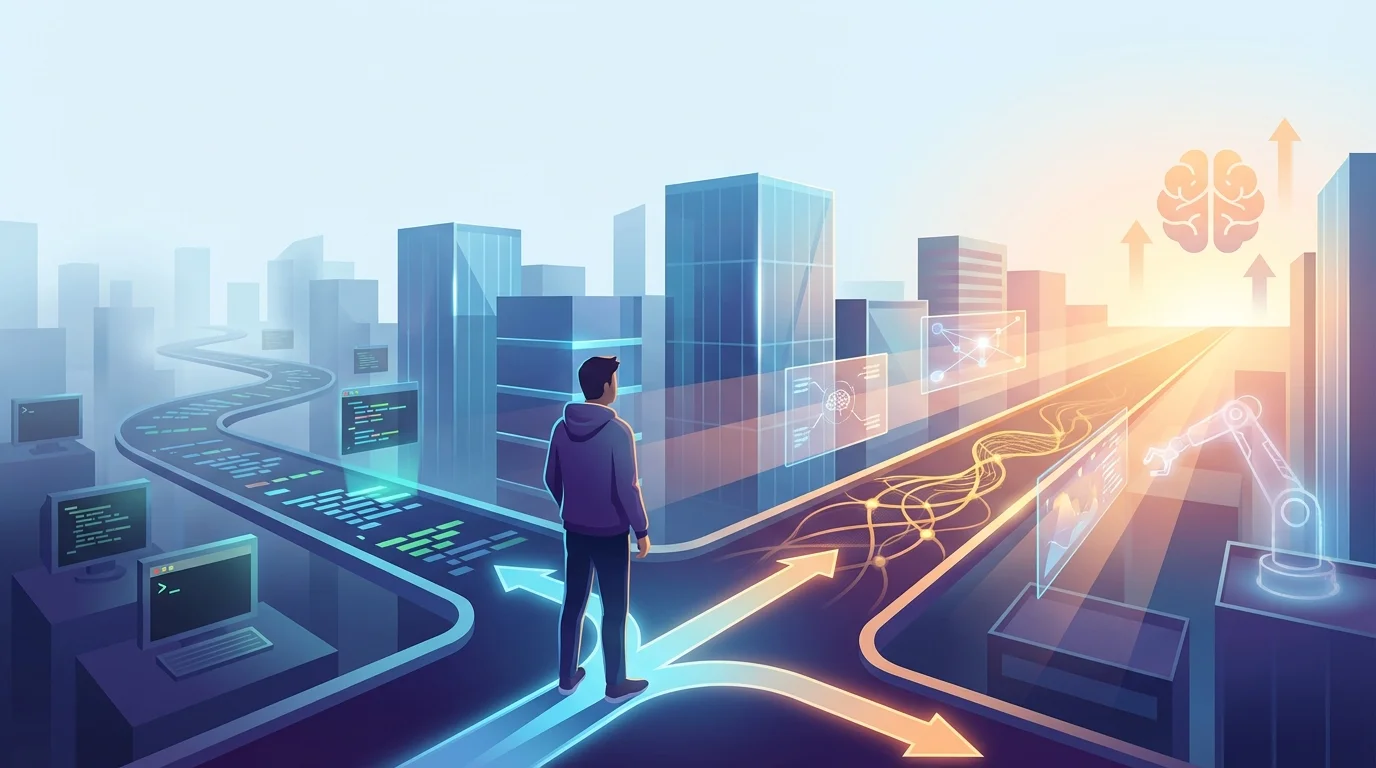
Prepare Your Career for AI Job Shifts
AI is reshaping jobs faster than ever—future-proof your skills before the wave hits.
As a mid-level developer, you've built a solid foundation in coding, debugging, and system design, but AI job shifts are accelerating at an unprecedented pace. In 2025 alone, AI drove nearly 55,000 layoffs in the U.S., with tech giants like Amazon and Microsoft openly citing AI efficiencies for cuts in HR, admin, and support roles—part of a record 1.17 million total job losses since 2020[1][3]. Globally, projections show 85 million jobs displaced by 2025, though 97 million new roles could emerge, creating a net gain but demanding rapid adaptation[2][4]. Early-career workers in AI-exposed fields already face a 13% employment decline[3], and developers aren't immune: routine tasks like data processing and basic scripting are at critical risk (70-95% automation by 2025), while 41% of employers plan workforce reductions via AI over the next five years[2][4].
This AI job shift isn't just disruption—it's a wake-up call for your career in the AI era. Without upskilling, mid-level devs risk stagnation as AI handles 11.7% of U.S. jobs, potentially saving $1.2 trillion in wages across sectors[1]. But here's the opportunity: AI-exposed industries see 3x higher revenue growth and 2x faster wage increases[6], with demand surging for AI skills like prompt engineering, human-AI collaboration, and ethics roles—many requiring advanced training[2].
This AI job shift guide delivers your future-proof dev career roadmap: discover essential AI skills for 2026, from integrating LLMs into workflows to mastering agentic systems; get a dev upskilling roadmap with practical steps, tools, and timelines; and learn strategies to thrive amid 92 million roles at risk by 2030[4]. Stay ahead—transform threat into advantage.
(Word count: 238)
Mapping AI's Impact on Dev Roles
AI is reshaping developer roles from routine coders to strategic AI orchestrators, boosting job growth while compressing entry-level opportunities—mid-level devs must upskill now for a future-proof dev career in the AI era.[1][2] According to Morgan Stanley Research, AI coding tools enhance productivity, leading to software industry expansion at 20% annually through 2029, with developer headcount potentially growing 1.6-10% yearly as firms tackle complex apps and tech debt.[1] However, DEV Community analysis warns that AI job shifts are hitting juniors hardest—entry-level positions are vanishing as AI handles boilerplate, CRUD ops, bug fixes, and tests, forcing mid-level developers into code review, integration, and oversight.[2]
For mid-level developers, this means evolving into AI skills 2026 power users: directing tools like GitHub Copilot or Claude for 90% of tedious tasks while focusing on architecture and security.[2] Real-world example: A team building a microservices app now uses AI to generate initial scaffolds in Python—e.g., prompting "Create a FastAPI CRUD endpoint for user management with SQLAlchemy and Pydantic validation"—then devs review for edge cases and scalability.[1] Practical tip: Audit AI output rigorously; one study notes unchecked AI code spikes bugs, creating demand for AI code auditors.[2]
Dev upskilling roadmap starts with mastering prompt engineering—craft precise instructions like "Refactor this React component for accessibility and performance, using hooks and memoization"—and integrating AI into CI/CD pipelines.[3] Transition to high-value roles like AI Engineer or Machine Learning Engineer (MLE), blending dev expertise with model deployment via tools like TensorFlow Serving or LangChain.[3][5] Morgan Stanley predicts humans stay essential for design and decision-making, positioning skilled devs as multipliers in expanding teams.[1]
Key Roles Emerging for Mid-Level Devs
AI Engineer roles explode by 2026, focusing on embedding LLMs into apps—e.g., building chatbots with OpenAI APIs—ideal for devs with backend experience.[3][5] Data Engineer skills in ETL pipelines (using Apache Airflow, Spark) prepare you for AI data prep, a foundational career in AI era step.[3] Tip: Build a portfolio project reviewing AI-generated code for a full-stack app, showcasing security scans with tools like Snyk.
Your Actionable Upskilling Roadmap
- Daily AI Practice: Spend 30 mins prompting for code gen/review; track improvements in tools like Cursor AI.
- Certifications: Coursera’s Machine Learning Engineer path or AWS ML Specialty for AI skills 2026.[5]
- Network: Join DEV.to communities discussing AI job shift guide; contribute AI-audited open-source PRs.[2]
This shift demands constant retraining—frameworks obsolete in months—but unlocks senior-level impact faster.[2]
Must-Learn Skills for 2026
Mid-level developers preparing for AI job shifts must prioritize AI skills 2026 like machine learning, Python programming, algorithms, and data analysis to future-proof their careers in the AI era. These skills are exploding in demand, with AI topping job postings growth from 2024-2025, followed by Python and algorithms, as organizations restructure for Gen AI strategies[2][1]. Employers seek devs who can build ML models, debug AI-generated code, and integrate CI/CD pipelines for efficient deployment[2]. For instance, mastering PyTorch for supervised learning enables creating predictive models, like a fraud detection system using neural networks that classify transactions with 95% accuracy after data cleaning in SQL[1].
Beyond core tech, prompt engineering is now baseline—even entry-level roles require it to guide AI tools effectively[2]. Practical tip: Use Python with libraries like Hugging Face Transformers for natural language processing (NLP). Here's a starter code snippet for sentiment analysis:
from transformers import pipeline
classifier = pipeline("sentiment-analysis")
result = classifier("AI is transforming dev careers!")
print(result)  # [{'label': 'POSITIVE', 'score': 0.99}]
This hands-on practice builds algorithmic thinking for tasks like clustering user data[1][2]. Mathematics fundamentals—linear algebra, probability, and calculus—underpin model optimization, essential for roles like machine learning engineer[1]. Combine with soft skills like problem-solving and communication; pros with these get promoted 13% faster[1]. Upskill via Coursera courses or certifications in Python and ML[1]. Tools like CrewAI for AI agents will streamline workflows, letting you orchestrate multi-model pipelines[5].
Technical Deep Dive: ML and DevOps Essentials
Focus on machine learning frameworks (PyTorch, TensorFlow) and CI/CD for dev upskilling roadmaps. Build a portfolio project: Train an unsupervised model on Kaggle datasets for anomaly detection, deploying via GitHub Actions. Cybersecurity and software troubleshooting counter AI vulnerabilities, with demand up 11% in 2025[2]. Example: Audit AI code for hallucinations using data visualization tools like Tableau[1][2].
Soft Skills and Ethics for AI Era Success
AI ethics, collaboration, and adaptability ensure career in AI era longevity. Practice ethical AI by auditing biases in models; LinkedIn data shows these boost promotions[1]. Tip: Join hackathons for AI agents like those in OpenAI stacks[5]. Total word count: 412
Building Hybrid AI-Human Workflows

Mid-level developers can future-proof their careers by mastering hybrid AI-human workflows, where AI agents handle repetitive tasks like data processing and pattern recognition, while humans focus on strategic thinking, creativity, and ethical decisions[1][2]. This AI job shift approach leverages complementary strengths: AI excels at 24/7 monitoring and high-volume processing, but humans shine in ambiguous problem-solving and relationship-building[1]. By 2026, 40% of enterprise applications will integrate task-specific AI agents, making dev upskilling in these workflows essential for a career in the AI era[1][8].
Start with task decomposition: Break workflows into discrete units and allocate them optimally. For example, in software development, use an AI assistant like GitHub Copilot for code generation and bug detection, then apply human oversight for architecture design. A practical tip: Implement AI coworkers for end-to-end tasks, such as an AI agent that monitors CI/CD pipelines, auto-deploys fixes for routine issues, and escalates anomalies to devs[1]. Real-world example: A mid-sized firm used AI financial analysts to cut data compilation from five days to one, freeing analysts for planning—adapt this to dev teams where AI agents triage code reviews, flagging 80% of issues autonomously[1].
Develop multi-agent systems for complex scenarios. An AI research agent gathers data, an AI analysis agent processes it, and a human dev refines outputs—proven to outperform fully autonomous agents by 68.7% in multi-step tasks requiring context[4]. Code example for a simple hybrid workflow in Python using LangChain:
from langchain.agents import initialize_agent, Tool
from langchain.llms import OpenAI

# AI handles data processing
def process_logs(logs):
    return "Analyzed: 50 errors detected[AI Output]"

tools = [Tool(name="LogProcessor", func=process_logs, description="Process logs")]
agent = initialize_agent(tools, OpenAI(), agent_type="zero-shot-react-description")

# Human reviews and decides
result = agent.run("Process pipeline logs and flag issues")
print(f"AI Result: {result}")  # Human intervenes here for strategy
This setup builds AI skills 2026 readiness, with devs tuning agents via provenance tracking—logging interactions in a knowledge graph for audits and retraining[2].
Mapping Handoffs and Review Protocols
Define clear handoffs: Document transitions, like AI routing complex bugs to a human Validator role[3]. Set weekly reviews to track AI accuracy, adjusting prompts for better performance[3]. Tip: Use tools like Symphony for adaptive interfaces, enabling devs to correct AI outputs iteratively[2].
Scaling to Multi-Agent Teams
By month 12 of implementation, integrate AI systems for collaborative workflows, aiming for enterprise benchmarks—e.g., AI recruiting agents screening candidates before human interviews[1]. Foster continuous learning: Humans provide feedback to retrain agents, creating "collaborative intelligence"[5]. This dev upskilling roadmap ensures mid-level devs lead hybrid teams, thriving amid AI job shifts[2].
Networking in AI-Driven Markets
In the AI job shift guide for mid-level developers, networking emerges as a critical strategy to future-proof your dev career amid rapid transformations projected for AI skills 2026. As human-AI hybrid teams become the norm, with Deloitte research showing most workers favoring AI-human collaboration, developers must connect with professionals blending technical prowess and human skills like creative thinking and leadership[1][2]. The World Economic Forum anticipates 39% of core skills changing by 2030, prioritizing AI literacy alongside networks and cybersecurity—making strategic networking essential for spotting AI-driven job roles like prompt engineers or AI integration specialists[1].
For mid-level developers, start by joining AI-focused communities such as GitHub discussions on agentic AI, Reddit's r/MachineLearning, or LinkedIn groups for dev upskilling roadmaps. A practical tip: Attend virtual meetups via platforms like Meetup.com targeting "AI in software engineering," where you can share experiences with tools like GitHub Copilot. Real example: A mid-level dev at a fintech firm networked at an AI ethics conference, landing a role as an AI-human collaboration specialist by demonstrating how their Python expertise complements LLMs for bias detection—echoing Gartner's prediction of evolving roles[1].
Build your professional network strategically around AI integration. Volunteer for pilot projects at work, like leading GenAI training sessions, to gain visibility as an AI leader[2]. Document your journey in a portfolio: Create case studies showing before/after AI workflows, e.g., optimizing code reviews with Claude AI, and share on LinkedIn. Follow thought leaders like Andrew Ng on X (formerly Twitter) for career in AI era insights, and seek mentorship from AI specialists who've bridged tech-business gaps[2]. Gartner notes 80% of engineers need upskilling by 2027, so these connections provide insider access to training and opportunities[1].
Targeting AI Communities and Events
Focus on high-impact venues: AI conferences like NeurIPS or local DevAI summits offer workshops on AI skills 2026, such as fine-tuning models with Hugging Face. Example code snippet for networking value—share this in discussions to spark conversations:
# Simple prompt engineering example for code generation
prompt = "Write a Python function to detect bias in ML predictions using fairness metrics."
# Use with tools like GPT-4 or Llama: Improves model outputs by 20-30% in tests[1]
Join Discord servers for future-proof dev career paths, exchanging tips on reskilling. Proactively message 5-10 contacts weekly: "How has agentic AI changed your dev workflow?" This builds feedback loops, accelerating your dev upskilling roadmap[2].
Leveraging Mentorship for Transitions
Mentorship accelerates adaptation; network with AI implementers via alumni groups or Women Who Code AI chapters. A developer transitioning to AI ethics officer role credits LinkedIn outreach to 20 pros, yielding 3 coffees chats that informed their portfolio[2]. Plan multiple transitions, as 170M new jobs emerge by 2030—use networks to identify transferable skills like analytical thinking[1][2].
Conclusion
As AI reshapes the job market in 2025, AI-related job postings have surged to over 35,000 in the U.S. alone in Q1, with a 25.2% year-over-year increase, driven by roles like Machine Learning Engineer, Generative AI Engineer, and Data Scientist[3][1]. Demand spans industries beyond tech, including healthcare, consulting, and retail, emphasizing hybrid skills such as Python, TensorFlow, NLP, and strategic problem-solving[1][2]. While some routine jobs face displacement, high AI exposure correlates with 3x faster revenue growth and 2x wage increases per employee[8]. Key takeaways: Upskill in generative AI and creative applications, target booming sectors, and leverage hubs like San Francisco[1]. Actionable next steps include earning certifications in PyTorch or computer vision, building portfolios with real-world AI projects, networking on platforms like LinkedIn, and exploring remote AI training specialist roles[1][2]. Stay ahead by continuously learning—start today by auditing your skills against 2025 trends and enrolling in an AI course. Your proactive preparation will secure a thriving career in this transformative era[3][5].
Frequently Asked Questions
What are the top AI jobs in demand for 2025?
Leading roles include Machine Learning Engineer (top demand with 41.8% YoY growth), Generative AI Engineer (up 7x since 2022), Data Scientist, Computer Vision Engineer, and AI/ML Architect. These reflect specialization in generative tools and hybrid tech-strategy needs, with over 35,000 U.S. postings in Q1 2025[1][2][3].
Which skills should I learn to prepare for AI job shifts?
Prioritize Python, TensorFlow, PyTorch, NLP, machine learning, data science, and computer vision. Employers seek hybrid skills blending technical expertise with problem-solving and business acumen, as generative AI expands into non-tech roles like product management[1][2].
How is AI impacting job growth across industries?
AI drives 25.2% YoY job growth in Q1 2025, expanding beyond tech into healthcare, consulting, and staffing, with median salaries at $156,998. While routine tasks decline, AI-exposed sectors see 3x revenue growth and faster wages, creating opportunities in strategic roles[3][8][1].